
lunes, 2 de diciembre de 2013
Creeping Determinism
They say hindsight is 20/20, ideal for evoking regret. But sight in the now? 20/200, ideal for what else but evoking the mayhem that evokes regret.

miércoles, 27 de noviembre de 2013
Life-recycling
It was 7 a.m. after a bloody and sleepless night. There was a light and eerie mist that enveloped our drab scrubs as we silently strolled to Food for breakfast. The ambiance changed immediately once we stepped into the warm restaurant, the inviting smell of sizzling omelets and bacon beckoning us ever so tenderly. It was like any other morning, the 3 of us just trying to endure another 24 hours of life-recycling. That's what we did for a living. We recycled the lives of Dreamers and gave them to the lives of non-dreamers. Carlos ordered the Belgian waffles. In his knowing tone of voice, he said, "When I met the girl I knew I would end up with, I did the smart thing and ran away." At first, I thought to myself, how silly. Who knew we were still life-recycling even on our breaks?
martes, 26 de noviembre de 2013
Was ist Sprache?
Was ist Sprache?
Musik ist die universelle Sprache.
Du spricsht auf Franzosisch.
Ich verstehe nichts.
Du singst auf Franzosich.
Ich verstehe alles.
Was ist Sprache?
Kunst ist die universelle Sprache.
Du sprichst auf Spanisch.
Ich verstehe nichts.
Du machst Kunst.
Ich verstehe alles.
Was ist Sprache?
Sprache ist Musik.
Sprache ist Kunst.
miércoles, 13 de marzo de 2013
Drinking carrot juice
I'm feeling restless. When I write, part of that restlessness evaporates. But it does just that - evaporates...it appears to disappear, it changes states, but is still very much there. I sit sipping on my drink, staring at the transparent skull that rests on my desk, illuminated by a strange yellow light. I'm pretending my body doesn't exist, that it's just the world and the little minion that sits so snugly in my brain. It's a story with no plot, no beginning and no ending. It's a story with just feelings.
viernes, 8 de febrero de 2013
Cosmicomics
I'd like to run naked in a forest without anyone to tell me it's wrong. My only coat would be my skin and my hair and the hard soles I would develop from running barefoot. And when I'm bored of running naked, I'd like to jump into a large lake and grow fins and gills and swim endlessly among other naked fishes. I would wait for dawn at the spot of water where the first rays of morning hit perfectly and reminisce at the wavering mirage of Land Things.
Dryness would be nothing more than a distant memory as I scuttle deeper and deeper into the sulfur-ridden unknown.
jueves, 13 de septiembre de 2012
Warning
How often we arrive at destinations we could never have imagined for ourselves. I think of all the possibilities I've yet to encounter and the ones I've missed, and I feel all the more ready to take another step forward. Sitting, waiting, wishing won't do us any good. No, siree, Jack Johnson, no siree.
martes, 25 de octubre de 2011
Stories
Beside the large window,
adorned with little champagne lights
sat the couple, couplet, deuce.
The smell of meatballs and wine
filled the cozy air,
of little Italy, the Hot Oven.
How often we make stories,
of things we don't know.
How often we make lives,
of people we don't know.
Take, for example,
the black-suited waitress.
She was an aspiring actress,
a real Betty Elms,
pursuing neo-noir thrill
and lavish vignettes,
now serving coffee to couples who--
amidst slurping oysters
and sipping pinot--
have become the directors
of her melancholy dream
adorned with little champagne lights
sat the couple, couplet, deuce.
The smell of meatballs and wine
filled the cozy air,
of little Italy, the Hot Oven.
How often we make stories,
of things we don't know.
How often we make lives,
of people we don't know.
Take, for example,
the black-suited waitress.
She was an aspiring actress,
a real Betty Elms,
pursuing neo-noir thrill
and lavish vignettes,
now serving coffee to couples who--
amidst slurping oysters
and sipping pinot--
have become the directors
of her melancholy dream
domingo, 16 de enero de 2011
Trajectory of a Tourist
11:30 a.m. 20 de marzo, 2010. Managua, Holiday Inn Hotel.
"Ochenta córdobas." Para una Toña?* Clad in a short black dress and heels thrice as high as anything I've ever worn, the casino waitress gave me a nod. Si, why not? I was a pre-21 year-old American in Nicaragua, incensed by the fact that my own government was depriving me of alcohol, but could possibly send me to my death fighting in another one of its imperialist encroachments into impoverished Latin American countries. Claro, another Toña sounded about right.
“Gracias.”
I received the ice cold bottle of beer, simultaneously proud and disappointed at how effortlessly I could get my hands on alcohol. The casino waitress responded with a look of sadness in her eyes, “De nada.” Instead of being home with her children, she was stuck here serving obnoxious Americans who ordered drinks in the middle of the day, Americans who stayed in exclusive enclaves of marble pillars and already made beds while she stayed in dark, damp casinos, Americans whose pretentious travelling tendencies she unfortunately depended on to make a living.
And that's when I did something I slightly regret. I played the haughty anthropologist. Thinking myself a considerate human being, I attempted to “observe” the cultural mannerisms of this woman’s society as if she were a specimen to be studied, not realizing my pompous nerve to show off my Spanish-speaking skills. Pen and paper in hand, I asked her if she liked her job. I asked her if she had any family, if she wanted to travel outside of Nicaragua. I asked her if she was happy, and finally, I asked her if she liked Americans. She laughed politely and answered most of my questions. “Sí, me gusta mi trabajo. Tengo dos hijos. No quiero viajar, y sí, estoy feliz.”
5:00 p.m. 23 de marzo, 2010. El Mercado de Granada.
Today, we went to the souvenir market outside the Alahambra, our hotel in Granada. Granada, also known as la Gran Sultana del Gran Lago -- as it borders Lake Nicaragua -- possesses much historical beauty and cultural aesthetic. Rocky roads of pebble stone, uprooted by sparse and scattered vegetation; quaint abodes of soft salmon pink and warm mustard yellow, situated in close proximity to the local marketplace; and grand exquisite cathedrals towering over the city, asserting their long-established Roman Catholic influence. No casinos, no air-conditioned malls, no large-scale discotheques.
At the market, Enrique, a skinny boy in a blue shirt and broken sandals came up to me and asked me for money.
“Señora, tiene córdobas? Tengo hambre y no he comido nada desde la mañana.”
Naturally, my first instinct was to reach into my pocket and spare just enough money to be selfless but still have enough to buy gifts for friends and family. (Paradigm of the cultured and kindhearted tourist?) Now Enrique was smart. He latched onto my friend, Neda, burrowing his head into her shoulder, obviously having practiced this tactic on many a naïve visitors before. Needless to say, we knew that begging was a way for the children here to opt out of school and pursue a vagabond way of life roaming the streets. It was understandable. Education was a long-term investment, while begging provided an immediate source of money.
We denied Enrique, big round eyes and all. Considering he followed us around for an hour before returning to his parents’ water-vending booth, it wasn’t easy. It certainly wasn’t gratifying at the moment, as every other tourist he targeted seemed to have no internal moral dilemma of slipping him a 20-cordoba bill.
But it was the best thing to do, for Enrique, and for la juventud de Nicaragua.
3:00 p.m. 28 de marzo, 2010. Al orfanato en Granada.
She reminded me a bit of my mother. Helen Ruiz was a 5’3”, middle-aged, goofy-smiled woman. I met her at the orphanage. She had the likes of a chubby squirrel, bushy-tailed, a bit disheveled, chattering away at any chance she found. She was also a skilled seamstress, sewing designs onto pillowcases and selling them for only 60 córdobas a pair.
“Sabes coser, mija?”
“Sí. Siempre me ha gustado coser.”
“Bueno. Puedes completar esto, si quieres.”
She handed me a light yellow pillowcase with a half-finished floral pattern, every stitch handled with the utmost care. In an attempt to display my nimble sewing skills, I approached the pillow with confidence, swiftly piercing it with the delicate needle. Needless to say, with thin pieces of thread sticking out, the stitch did not hold half the amount of care she had put into hers.
“No, mija, esto es la manera correcta de hacerlo.” With that goofy smile, Helen carefully taught me how to stitch up the last scarlet rose petal. Mano en mano, I felt a fleeting sense of spirituality tingling in her fingertips as she guided mine.
I asked no more questions, I no longer felt the need to regurgitate the Spanish words I happened to remember from class. I saw Helen as a maternal figure.
“Gracias.”
“De nada, mija.”
2:00 p.m. 29 de marzo, 2010. Saliendo Granada por autobús.
VIVA LA JUVENTUD! VIVA EL FSLN. LA REVOLUCION.
I saw the words scrawled in big black letters across a somber pine green fence straddling one of the main streets of Granada. I am not a revolutionary of any kind, or a starry-eyed nationalist, nor am I the least bit Central American. I am American, the same kind of American that forcefully imposed a despotic military general onto Nicaragua’s throne years ago and set up counterrevolutionary forces against the Sandinistas; the same American that had a week ago, been the sophomoric progenitor of “culture”, asking hollow questions and observing, but not absorbing.
I am still that American. I want to travel up, down, and across Central and South America, exploring and soaking in the ambiance of foreign societies. But I no longer wish to play the role of the pretentious anthropologist. After a week in Nicaragua, I’ve realized the best way to understand human culture is not through quizzical inquiries and observations, but rather through encounters:
Encounters with the casino workers.
Encounters with the Enriques.
And most certainly,
encounters with the Helen Ruizes.
Y eso es la trayectoria de una turista.
(La Gente Newsmagazine)
"Ochenta córdobas." Para una Toña?* Clad in a short black dress and heels thrice as high as anything I've ever worn, the casino waitress gave me a nod. Si, why not? I was a pre-21 year-old American in Nicaragua, incensed by the fact that my own government was depriving me of alcohol, but could possibly send me to my death fighting in another one of its imperialist encroachments into impoverished Latin American countries. Claro, another Toña sounded about right.
“Gracias.”
I received the ice cold bottle of beer, simultaneously proud and disappointed at how effortlessly I could get my hands on alcohol. The casino waitress responded with a look of sadness in her eyes, “De nada.” Instead of being home with her children, she was stuck here serving obnoxious Americans who ordered drinks in the middle of the day, Americans who stayed in exclusive enclaves of marble pillars and already made beds while she stayed in dark, damp casinos, Americans whose pretentious travelling tendencies she unfortunately depended on to make a living.
And that's when I did something I slightly regret. I played the haughty anthropologist. Thinking myself a considerate human being, I attempted to “observe” the cultural mannerisms of this woman’s society as if she were a specimen to be studied, not realizing my pompous nerve to show off my Spanish-speaking skills. Pen and paper in hand, I asked her if she liked her job. I asked her if she had any family, if she wanted to travel outside of Nicaragua. I asked her if she was happy, and finally, I asked her if she liked Americans. She laughed politely and answered most of my questions. “Sí, me gusta mi trabajo. Tengo dos hijos. No quiero viajar, y sí, estoy feliz.”
5:00 p.m. 23 de marzo, 2010. El Mercado de Granada.
Today, we went to the souvenir market outside the Alahambra, our hotel in Granada. Granada, also known as la Gran Sultana del Gran Lago -- as it borders Lake Nicaragua -- possesses much historical beauty and cultural aesthetic. Rocky roads of pebble stone, uprooted by sparse and scattered vegetation; quaint abodes of soft salmon pink and warm mustard yellow, situated in close proximity to the local marketplace; and grand exquisite cathedrals towering over the city, asserting their long-established Roman Catholic influence. No casinos, no air-conditioned malls, no large-scale discotheques.
At the market, Enrique, a skinny boy in a blue shirt and broken sandals came up to me and asked me for money.
“Señora, tiene córdobas? Tengo hambre y no he comido nada desde la mañana.”
Naturally, my first instinct was to reach into my pocket and spare just enough money to be selfless but still have enough to buy gifts for friends and family. (Paradigm of the cultured and kindhearted tourist?) Now Enrique was smart. He latched onto my friend, Neda, burrowing his head into her shoulder, obviously having practiced this tactic on many a naïve visitors before. Needless to say, we knew that begging was a way for the children here to opt out of school and pursue a vagabond way of life roaming the streets. It was understandable. Education was a long-term investment, while begging provided an immediate source of money.
We denied Enrique, big round eyes and all. Considering he followed us around for an hour before returning to his parents’ water-vending booth, it wasn’t easy. It certainly wasn’t gratifying at the moment, as every other tourist he targeted seemed to have no internal moral dilemma of slipping him a 20-cordoba bill.
But it was the best thing to do, for Enrique, and for la juventud de Nicaragua.
3:00 p.m. 28 de marzo, 2010. Al orfanato en Granada.
She reminded me a bit of my mother. Helen Ruiz was a 5’3”, middle-aged, goofy-smiled woman. I met her at the orphanage. She had the likes of a chubby squirrel, bushy-tailed, a bit disheveled, chattering away at any chance she found. She was also a skilled seamstress, sewing designs onto pillowcases and selling them for only 60 córdobas a pair.
“Sabes coser, mija?”
“Sí. Siempre me ha gustado coser.”
“Bueno. Puedes completar esto, si quieres.”
She handed me a light yellow pillowcase with a half-finished floral pattern, every stitch handled with the utmost care. In an attempt to display my nimble sewing skills, I approached the pillow with confidence, swiftly piercing it with the delicate needle. Needless to say, with thin pieces of thread sticking out, the stitch did not hold half the amount of care she had put into hers.
“No, mija, esto es la manera correcta de hacerlo.” With that goofy smile, Helen carefully taught me how to stitch up the last scarlet rose petal. Mano en mano, I felt a fleeting sense of spirituality tingling in her fingertips as she guided mine.
I asked no more questions, I no longer felt the need to regurgitate the Spanish words I happened to remember from class. I saw Helen as a maternal figure.
“Gracias.”
“De nada, mija.”
2:00 p.m. 29 de marzo, 2010. Saliendo Granada por autobús.
VIVA LA JUVENTUD! VIVA EL FSLN. LA REVOLUCION.
I saw the words scrawled in big black letters across a somber pine green fence straddling one of the main streets of Granada. I am not a revolutionary of any kind, or a starry-eyed nationalist, nor am I the least bit Central American. I am American, the same kind of American that forcefully imposed a despotic military general onto Nicaragua’s throne years ago and set up counterrevolutionary forces against the Sandinistas; the same American that had a week ago, been the sophomoric progenitor of “culture”, asking hollow questions and observing, but not absorbing.
I am still that American. I want to travel up, down, and across Central and South America, exploring and soaking in the ambiance of foreign societies. But I no longer wish to play the role of the pretentious anthropologist. After a week in Nicaragua, I’ve realized the best way to understand human culture is not through quizzical inquiries and observations, but rather through encounters:
Encounters with the casino workers.
Encounters with the Enriques.
And most certainly,
encounters with the Helen Ruizes.
Y eso es la trayectoria de una turista.
(La Gente Newsmagazine)
lunes, 1 de noviembre de 2010
Stifled
I crave the creative juices that used to nourish me.
Replaced by purplish varicose veins, mocking what I used to do!
And to think we are always in homeostasis.
Replaced by purplish varicose veins, mocking what I used to do!
And to think we are always in homeostasis.
martes, 28 de septiembre de 2010
Oh the Bagginses
Who knew! The Hobbit - in my opinion, the best of J.R.R. Tolkien. But an entire feature-length film based primarily on hairy feet, grassy hills, and Bilbo Baggins? Send Jackson some good vibes.
domingo, 5 de septiembre de 2010
My new friend Mao
Travelling across China for seven days - Shanghai, Hangzhou, and Beijing - left with me a tactful inclination towards many things.
1. Sipping tea with every meal
2. Chugging beer with every meal
3. Spitting watermelon seeds into tea cups with every meal
4. Gaining thunder thighs with hole-in-the ground toilets
5. Gaining thunder thighs climbing the Great Wall
6. Haggling to less than 1/2 beginning price skills
7. Meditating with monks
8. Eating stinky tofu
9. Befriending Mao
I am now ready to take on the world!
Tactfully,
T.J.
1. Sipping tea with every meal
2. Chugging beer with every meal
3. Spitting watermelon seeds into tea cups with every meal
4. Gaining thunder thighs with hole-in-the ground toilets
5. Gaining thunder thighs climbing the Great Wall
6. Haggling to less than 1/2 beginning price skills
7. Meditating with monks
8. Eating stinky tofu
9. Befriending Mao
I am now ready to take on the world!
Tactfully,
T.J.
miércoles, 25 de agosto de 2010
Me love you long time.
If you think L.A. has a vibrant night life, you clearly haven’t been to Saigon -- also known as Ho Chi Minh City to the Che-revering fans out there. (I actually met an old man on my flight wearing the generic Che tee, to which I commented, “Sir, I enjoy your choice in T-shirts” and to which he kindly responded, “Thank you.”)
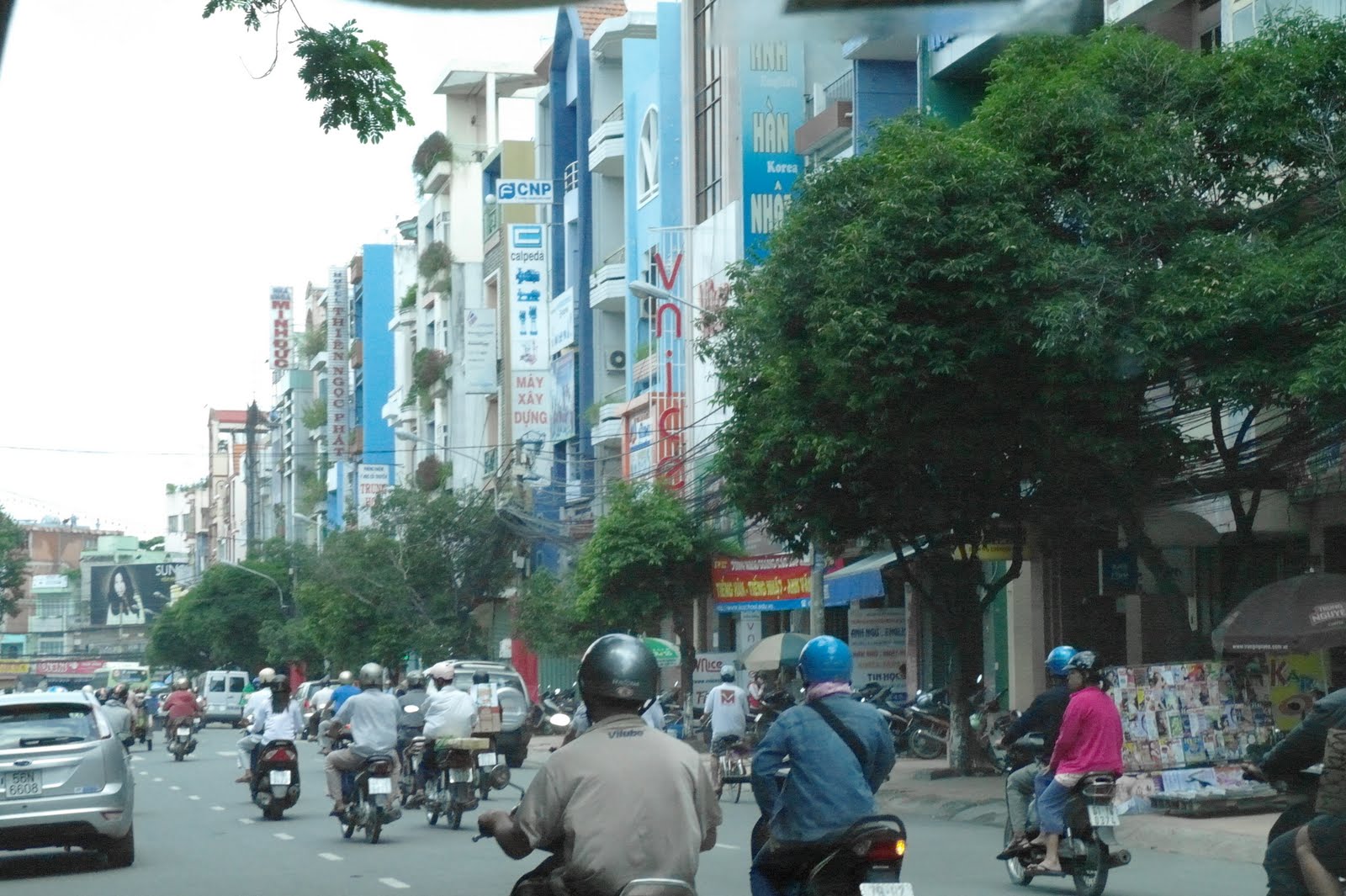
The hustle and bustle of the endless stream of motorcycles here is unmatched by the endless stream of party break-ups and drunken yelling you’d find in LA on any common night. Most of the racket I attribute to the absence of traffic regulations in Saigon, causing the need for a million and one honks of the horn per person on a scooter. I’ve seen up to 3 people per vehicle, which correlates to 3 million and 3 honks in one night per one scooter. Actually, I was one of those 3 and needless to say, received a front row seat with unbeatable acoustics.
Now, you might be asking yourself, why am I stuck behind a monitor typing away to the pacifying sounds of squealing brakes and almost-crashes instead of immersing myself in the amazing culture that is Vietnam? Well, for one, it’s about 10 pm here (13 hours ahead of the Pacific time zone) and unless you’ve got a young friend or cousin to take you to a club, you’re likely to find yourself 1) out for an after-dinner snack/drink excursion with your parents, which I would love, but alas, they are sleeping and I’d rather not go alone, for I am female and we of course by law are vulnerable, helpless things, or 2) you could find yourself clubbing with your parents. But, alas. My parents are sleeping.
So why am I not sleeping and re-energizing myself for the morrow? Well, thanks to the time difference, I just woke up.
But, thankfully, my first day in Vietnam did not just consist of arriving and sleeping. I visited my relatives I haven’t seen for so long and ate great food! (with not so great after effects, but I go to Taco Bell all the time so I’m pretty much used to it).
Photos below:
1. Barely any traffic rules. Or if there are any, very poorly enforced. There were motorcycles flying at us left and right.
2. Vịt (duck)
3. Bún (noodes), bánh mì (bread). A classic soup dish, eaten with chả (pork), bò viên (beef meatballs), and garnished with green onions to balance the meat.
4. Thanh long (dragon fruit or pitaya), măng cụt (mangosteen). Dragon fruit, with a mushy white interior and black seeds, is the product of a cactus cultivated in Southeast Asia and Mexico/South America. Mangosteen is a slightly sour white fruit divided into 4 or 5 parts and surrounded by a hard dark purple shell. It's endemic to Southeast Asia, but is only in season from May to August. Just made it!
5. Bánh canh cua (crab soup). Never had this before, but I'm eating it as a midnight snack because I did not wake up in time to go out for dinner. Dầu cháo quẩy (the pastry pieces you see inside) are common to eat with hot soups.


Tactfully,
T.J.
The hustle and bustle of the endless stream of motorcycles here is unmatched by the endless stream of party break-ups and drunken yelling you’d find in LA on any common night. Most of the racket I attribute to the absence of traffic regulations in Saigon, causing the need for a million and one honks of the horn per person on a scooter. I’ve seen up to 3 people per vehicle, which correlates to 3 million and 3 honks in one night per one scooter. Actually, I was one of those 3 and needless to say, received a front row seat with unbeatable acoustics.
Now, you might be asking yourself, why am I stuck behind a monitor typing away to the pacifying sounds of squealing brakes and almost-crashes instead of immersing myself in the amazing culture that is Vietnam? Well, for one, it’s about 10 pm here (13 hours ahead of the Pacific time zone) and unless you’ve got a young friend or cousin to take you to a club, you’re likely to find yourself 1) out for an after-dinner snack/drink excursion with your parents, which I would love, but alas, they are sleeping and I’d rather not go alone, for I am female and we of course by law are vulnerable, helpless things, or 2) you could find yourself clubbing with your parents. But, alas. My parents are sleeping.
So why am I not sleeping and re-energizing myself for the morrow? Well, thanks to the time difference, I just woke up.
But, thankfully, my first day in Vietnam did not just consist of arriving and sleeping. I visited my relatives I haven’t seen for so long and ate great food! (with not so great after effects, but I go to Taco Bell all the time so I’m pretty much used to it).
Photos below:
1. Barely any traffic rules. Or if there are any, very poorly enforced. There were motorcycles flying at us left and right.
2. Vịt (duck)
3. Bún (noodes), bánh mì (bread). A classic soup dish, eaten with chả (pork), bò viên (beef meatballs), and garnished with green onions to balance the meat.
4. Thanh long (dragon fruit or pitaya), măng cụt (mangosteen). Dragon fruit, with a mushy white interior and black seeds, is the product of a cactus cultivated in Southeast Asia and Mexico/South America. Mangosteen is a slightly sour white fruit divided into 4 or 5 parts and surrounded by a hard dark purple shell. It's endemic to Southeast Asia, but is only in season from May to August. Just made it!
5. Bánh canh cua (crab soup). Never had this before, but I'm eating it as a midnight snack because I did not wake up in time to go out for dinner. Dầu cháo quẩy (the pastry pieces you see inside) are common to eat with hot soups.


Tactfully,
T.J.
viernes, 20 de agosto de 2010
The War of 2010
Smoky ghosts escape from the rusty depths of hell
to be dissipated in oxygen and nitrogen.
It's a trade-off of convenience and death feigned as an unnecessary necessity.
Crests and troughs of land as far as the mind can see,
replaced by the rigid silhouette of a corporate state.
Your army infiltrates existence in every crook and nanny.
The fear of spiritual genocide hovers
or the fear that it has already happened.
to be dissipated in oxygen and nitrogen.
It's a trade-off of convenience and death feigned as an unnecessary necessity.
Crests and troughs of land as far as the mind can see,
replaced by the rigid silhouette of a corporate state.
Your army infiltrates existence in every crook and nanny.
The fear of spiritual genocide hovers
or the fear that it has already happened.
miércoles, 18 de agosto de 2010
Fermented fish sauce
Sometimes external thingymajigs can really bog you down. I'm happy about this month-long trip to Vietnam. Gives me time to do things I've been neglecting, think about things I've forgotten to think about. Follow me on what I deem will be a rather interesting cultural explosion. I'm about ready to experience life in the slow lane, just for the time being.
Tactfully,
T.J.
Tactfully,
T.J.
domingo, 8 de agosto de 2010
viernes, 30 de julio de 2010
A gummy bear a day
Currently listening to Seventeen Years by Ratatat.
Do you know the sensation of falling as the world stands steady. Or maybe the world caving in as you stand steady. It starts to pour colors like the spots behind shut eyelids, or a really bad electro music video. There is that distant, constant muffling of reverberating bass that you can't quite make out, I think it sounds like Terry Crew flexing his tits. It smells fishy, like fish sauce. And a little sweet, like the smell of 6 egg custard tarts drifting from the oven. It's pleasant. Then you wake up, and realize you've taken an unwanted 3 hour snooze while writing a very important lab paper. Shiezy!
Do you know the sensation of falling as the world stands steady. Or maybe the world caving in as you stand steady. It starts to pour colors like the spots behind shut eyelids, or a really bad electro music video. There is that distant, constant muffling of reverberating bass that you can't quite make out, I think it sounds like Terry Crew flexing his tits. It smells fishy, like fish sauce. And a little sweet, like the smell of 6 egg custard tarts drifting from the oven. It's pleasant. Then you wake up, and realize you've taken an unwanted 3 hour snooze while writing a very important lab paper. Shiezy!
miércoles, 9 de junio de 2010
Dear friend,
Would you travel the world with me? To the mountains of Peru, to the ruins of the Berlin Wall, to the butterfly gardens of Thailand, to the moon and back? Would you eat anything and everything edible from every country with me and taste all the whiskeys and Tecates of the world? Would you play the guitar for me while I fall asleep? Would you salsa with me at professional salsa parties and on the roofs of elementary schools after midnight? Would you drive with me through the city at night and stop by janky hicktown shops to buy overpriced English chocolate bars? Would you cook exotic and experimental meals and bake delicious mint chocolate raspberry cakes with me? Would you take me to sand dunes overlooking the ocean, the stars overlooking us? Would you escape with me on spastic journeys for absolutely no reason?
Would you?
Could you?
Would you?
Could you?
martes, 8 de junio de 2010
A message not intertwined in an esoteric tale concocted to confuse you
Contrived self-pitying may give you the emotional foundation you necessitate to achieve the stance of "bona fide artist", but it will also grant you the worst of perspectives. It'll consume you when you least expect it. A self-administered drug of sorts.
lunes, 24 de mayo de 2010
Concert Caveats: Edward Sharpe & the Magnetic Zeroes
May 20. 8:00 p.m. Royce Hall.
Meet Jade.
She was convinced that Alex Ebert was a musical messiah sent down to Earth to purge humankind of all that was sinister and blasphemous in the world and remind them of all that was good and beautiful. Prancing barefoot in a wrinkled white suit, a loose red scarf, and a personifiable shaggy mane, Ebert created no hierarchy within the 10-member folk-rock band Edward Sharpe & the Magnetic Zeroes. All was one and one was all with this hippie god. And the sentiment of collectivism was not exclusive to the stage: the audience, the staff, the ushers all fell under the unifying spell of musical madness.
She suspected Edward Sharpe appealed to the average college student because in both music and conduct, he exuded the ambiance of sixties counterculture rebellion, which, living in LA, she all knew too well. But who could blame them? They were all dependent children, on the verge of leaving the cuckoo's nest, and what better way to be individuals than by a means of "revolution"? She found this attempt at revolution ironically cyclic. In trying to break away from conventions of their parents, they ended up being thrown into the world of adulthood all the more quickly while all the more ill-equiped. Demonstrating their unsolicited valiance in raunchy and illegal doings were great fun at the moment, but it was short-lived. In the end, the consequences they faced for their endeavors at being unorthodox would become the catalysts to their adulthood and maturity.
In their safe beds and purely rhetorical classroom debates, they said they wanted revolution and change, yet when the time came, who but a few would rush to the front of the line eager to defend their cause? Who but a few would be strong enough to speak out from the safety of their numerous and nameless mob companions? Who, among the mass of college students, regurgitating what they heard on TV and preaching obsolete ideals from history no longer relevant, would be a martyr for egalitarian principles? Not one. The liberal front had become somewhat of a fad. And those who followed wore faux-vintage dresses and tees from Urban Outfitters and bought every single book about journal-keeping or peace on its shelves.
She was reluctant to say more. She loved Edward Sharpe nonetheless. He was the kind of man that made her jump out of her seat to dance while everyone else sat. He was the kind of man that could make every body in the audience of a 1,833-capacity theatre silent with a single request. She hated the idea behind him, but Ebert himself, she could not stop loving.
Hypocrisy is both a vice and a virtue.
Tactfully,
T.J.
Meet Jade.
She was convinced that Alex Ebert was a musical messiah sent down to Earth to purge humankind of all that was sinister and blasphemous in the world and remind them of all that was good and beautiful. Prancing barefoot in a wrinkled white suit, a loose red scarf, and a personifiable shaggy mane, Ebert created no hierarchy within the 10-member folk-rock band Edward Sharpe & the Magnetic Zeroes. All was one and one was all with this hippie god. And the sentiment of collectivism was not exclusive to the stage: the audience, the staff, the ushers all fell under the unifying spell of musical madness.
She suspected Edward Sharpe appealed to the average college student because in both music and conduct, he exuded the ambiance of sixties counterculture rebellion, which, living in LA, she all knew too well. But who could blame them? They were all dependent children, on the verge of leaving the cuckoo's nest, and what better way to be individuals than by a means of "revolution"? She found this attempt at revolution ironically cyclic. In trying to break away from conventions of their parents, they ended up being thrown into the world of adulthood all the more quickly while all the more ill-equiped. Demonstrating their unsolicited valiance in raunchy and illegal doings were great fun at the moment, but it was short-lived. In the end, the consequences they faced for their endeavors at being unorthodox would become the catalysts to their adulthood and maturity.
In their safe beds and purely rhetorical classroom debates, they said they wanted revolution and change, yet when the time came, who but a few would rush to the front of the line eager to defend their cause? Who but a few would be strong enough to speak out from the safety of their numerous and nameless mob companions? Who, among the mass of college students, regurgitating what they heard on TV and preaching obsolete ideals from history no longer relevant, would be a martyr for egalitarian principles? Not one. The liberal front had become somewhat of a fad. And those who followed wore faux-vintage dresses and tees from Urban Outfitters and bought every single book about journal-keeping or peace on its shelves.
She was reluctant to say more. She loved Edward Sharpe nonetheless. He was the kind of man that made her jump out of her seat to dance while everyone else sat. He was the kind of man that could make every body in the audience of a 1,833-capacity theatre silent with a single request. She hated the idea behind him, but Ebert himself, she could not stop loving.
Hypocrisy is both a vice and a virtue.
Tactfully,
T.J.
jueves, 13 de mayo de 2010
Quail eggs and smelt eggs
Currently listening to Allison Weiss' MGMT cover of Kids. God, I revere the musically talented.
You know when people say, "You just know"? I really hate that. I think it's because I'm deathly afraid that I'll never have that just knowing epiphany. Is it purely emotional? Or is it more holistic than that? ...just knowing is a godforsakenly dangerous concept. It doesn't help that almost knowing or a contrived knowing can be easily mistaken as just knowing, especially since it's so sought-after and romanticized these days. I guess for me, just knowing comes when you aren't looking for it in particular, and when it does happen, it isn't as sensational as you might've imagined...when it's spontaneous, you could say. It's not the moment that matters, it's what happens after that moment that defines it and gives it any significance. The effect, the consequences, the aftermath. Because really, I could give a fuck that Obama was elected president. It's what he accomplishes or screws up after that fateful moment that will give his election any real value.
Tactfully,
T.J.
You know when people say, "You just know"? I really hate that. I think it's because I'm deathly afraid that I'll never have that just knowing epiphany. Is it purely emotional? Or is it more holistic than that? ...just knowing is a godforsakenly dangerous concept. It doesn't help that almost knowing or a contrived knowing can be easily mistaken as just knowing, especially since it's so sought-after and romanticized these days. I guess for me, just knowing comes when you aren't looking for it in particular, and when it does happen, it isn't as sensational as you might've imagined...when it's spontaneous, you could say. It's not the moment that matters, it's what happens after that moment that defines it and gives it any significance. The effect, the consequences, the aftermath. Because really, I could give a fuck that Obama was elected president. It's what he accomplishes or screws up after that fateful moment that will give his election any real value.
Tactfully,
T.J.
Suscribirse a:
Entradas (Atom)
